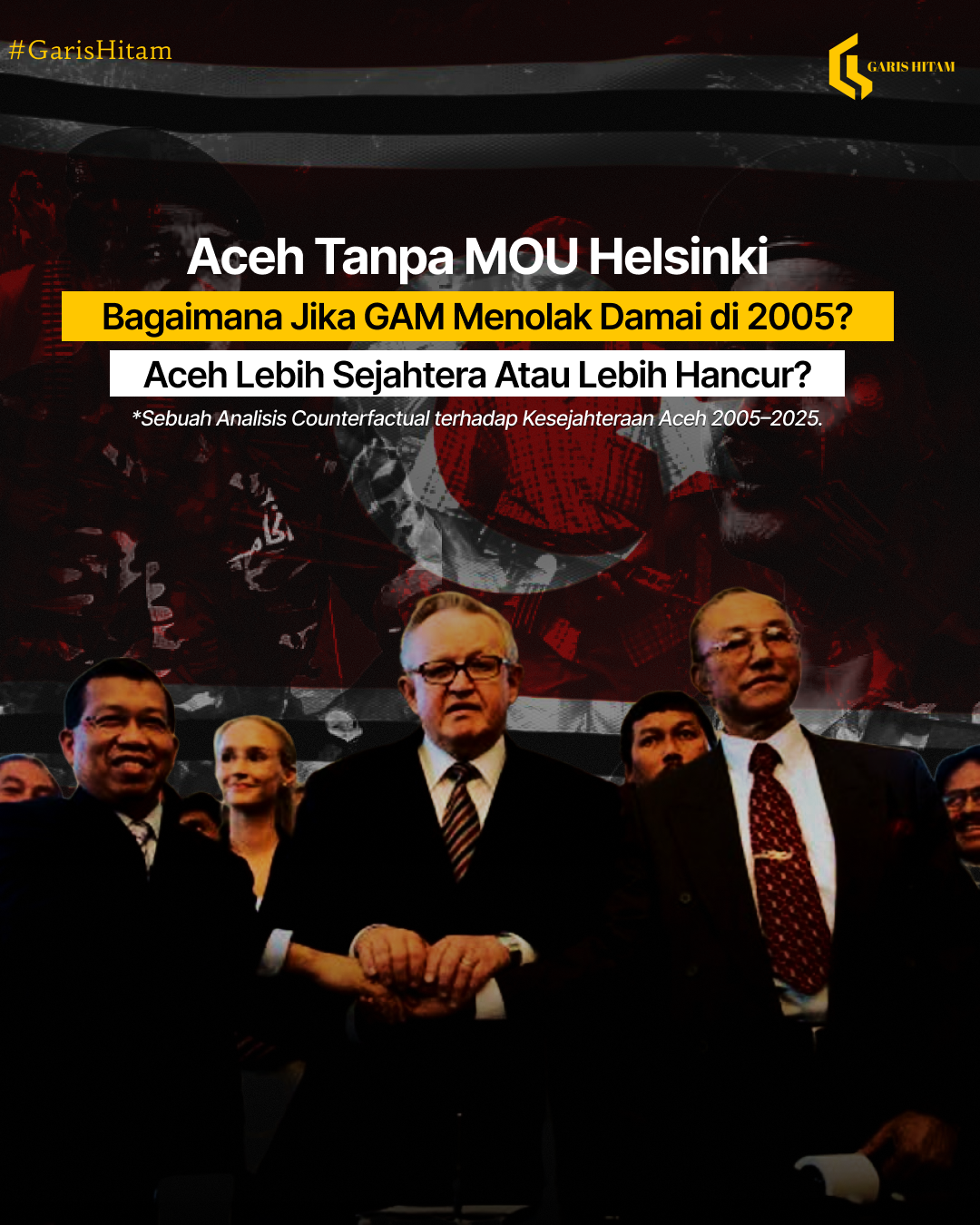
Dua puluh satu tahun setelah penandatanganan Memorandum of Understanding Helsinki pada 15 Agustus 2005, Garis Hitam menerbitkan assessment kuantitatif pertama yang membandingkan kesejahteraan Aceh di bawah jalur perdamaian historis dengan skenario penolakan perjanjian. Riset ini bukan argumen untuk atau melawan kemerdekaan Aceh — ia adalah alat ukur yang meletakkan perbandingan di atas data fiskal, ekonomi, dan sosial yang dapat diperiksa ulang.
The composite is a model-based welfare assessment, not a purely empirical measurement of welfare. Three of six dimensions are built from observed data; three are analyst judgement placed on the same scale by stated rules. A common arithmetic scale is not a common evidentiary status.
Abstract
Question. Twenty-one years after the Helsinki Memorandum of Understanding of 15 August 2005, would Aceh plausibly enjoy higher long-term welfare had the Free Aceh Movement (Gerakan Aceh Merdeka, GAM) rejected the agreement and continued to pursue independence?
Method. The study separates two tasks that are often conflated. Game theory is used to establish which outcomes were reachable from August 2005 and with what probability, through a multi-stage extensive-form game with incomplete information solved for Perfect Bayesian Equilibrium within a commitment-problem framework. Welfare values are then constructed separately from evidence, because payoffs in a game model are inputs rather than outputs and a model that “demonstrates” a welfare ranking has usually had that ranking placed in its payoff matrix by the analyst. Six welfare dimensions are scored on a single 0–10 reference frame whose anchors were declared before any comparison was computed.
Data. Two sources. The provincial budget series for Aceh, 2008–2025, reconstructed from Ministry of Finance regional fiscal records, audited local government financial statements, and statistical yearbooks. And a balanced district panel covering all 23 Acehnese districts and municipalities, 2005–2025, drawn from national statistical agency series. Three welfare dimensions (fiscal, economic, social) are built from raw indicators in these sources. Three (security, political, international) are analyst judgement placed on the same scale by stated rules, because adequate series were not available.
Observed evidence. Aceh’s provincial treasury received Rp 201.52 trillion in revenue over 2008–2025, of which Rp 161.52 trillion was central transfer and at least Rp 92.90 trillion was Special Autonomy Fund across fifteen years for which a dedicated line exists. Transfer dependency averaged 85.4 percent over 2008–2022 and stood at 74.8 percent in 2025. Over the same period, capital expenditure fell from 45.7 to 9.0 percent of the provincial budget while personnel expenditure rose from 11.2 to 31.4 percent. Poverty fell from 27.6 percent (2005) to 12.7 percent (2025) and the human development index rose from 65.84 (2010) to 75.98 (2025).
Counterfactual model. Under the central parameterisation, the historical settlement path yields a composite welfare score of 6.06 against an expected 3.95 for the rejection path, an advantage of 2.11 points. The advantage persists across weighting systems, independence probabilities, normalisation methods and aggregation choices. It is not universal: the optimistic independence branch scores 6.60, above the historical path, and the model identifies a bounded region of the parameter space in which the rejection path is preferred.
Central uncertainty. The three judgement-based dimensions account for approximately 74.2 percent of the measured advantage. The composite is a model-based welfare assessment, not a purely empirical measurement of welfare, and this report states that limitation wherever the composite is used.
Executive Summary
The question and why it is answerable
The counterfactual is politically sensitive and analytically tractable. This study takes no position on the legitimacy of Indonesian authority in Aceh or on the aspirations of the Acehnese independence movement. It asks a narrower question: what do the available evidence and formal modelling support, and what do they not?
The answer is conditional, and the conditions are stated throughout rather than reserved for a caveat at the end.
What the observed record shows
Fiscal. The Special Autonomy Fund dominated Aceh’s provincial revenue for fifteen years, averaging 56.6 percent of total revenue over 2008–2022 and never falling below 38.8 percent in any year for which it is recorded. Revenue autonomy improved substantially, from 2.3 percent of revenue in 2008 to a peak of 28.3 percent in 2024, driven by genuine gains in provincial tax administration. It has never approached self-sufficiency.
The expenditure record moved in the opposite direction. In 2008 the province spent Rp 4.08 on capital formation for every rupiah of personnel cost. By 2025 it spent Rp 0.29. The two series crossed between 2017 and 2018 and have not recrossed.
The 2023 fiscal shock. The statutory formula reduced the Fund from 2 percent to 1 percent of the national general allocation ceiling with effect from 2023. In the observed data, a 47.6 percent reduction in the Fund coincided with a 25.5 percent fall in total provincial revenue, a 33.5 percent fall in expenditure, and a 41.6 percent fall in capital expenditure, against a 5.0 percent fall in personnel expenditure. Budget execution improved to 94.5 percent, indicating that the adjustment was deliberate rather than administrative. The Fund terminates entirely in 2027.
Economic and human development. Both improved substantially and monotonically. Poverty fell from 27.6 to 12.7 percent. Gross regional product per capita rose from Rp 21.4 million (2010) to Rp 40.0 million (2023). Life expectancy rose from 67.31 to 68.83 years and mean years of schooling from 8.09 to 9.74. On the study’s common scale the economic dimension rose from 3.54 to 5.15 and the social dimension from 4.80 to 5.68.
None of this establishes causation. These movements coincided with the post-Helsinki period and are consistent with transfer-financed service provision. Indonesia’s national indicators moved in the same direction over the same interval, and no identification strategy is implemented here.
The welfare comparison
Six dimensions on a declared 0–10 frame. Scenario H is the historical settlement path.
Table 1. Historical settlement path: dimension scores and evidentiary status.
| Dimension | Score | Evidentiary status |
|---|---|---|
| Security | 8.80 | Judgement |
| International | 6.73 | Judgement |
| Fiscal | 5.71 | Empirical |
| Political | 5.70 | Judgement (institutional facts observed) |
| Social | 5.18 | Empirical |
| Economic | 4.24 | Empirical |
Composite under equal weights: 6.06.
The counterfactual branches and their composites:
Table 2. Composite welfare scores by branch, equal weights.
| Branch | Composite | Description |
|---|---|---|
| H Historical settlement | 6.06 | Observed |
| C1 Delayed, weaker settlement | 4.22 | Counterfactual |
| C2 Suppression and fragmentation | 3.70 | Counterfactual |
| C3 Frozen conflict | 2.85 | Counterfactual |
| I-opt Independence, optimistic | 6.60 | Counterfactual |
| I-base Independence, moderate | 4.88 | Counterfactual |
| I-pess Independence, pessimistic | 3.27 | Counterfactual |
The optimistic independence branch scores above the historical path. It does so while carrying a security penalty for the additional years of conflict required to reach independence and a fiscal penalty for the loss of central transfers. It wins on political self-determination and on economic and social performance under the optimistic assumptions specified in Section 6.
Expected welfare of the rejection path at the central independence probability of 0.06 is 3.95, giving the historical path an advantage of +2.11. The advantage arises because approximately 94 percent of the probability mass in the rejection scenario falls on branches involving continued conflict without independence.
1. Introduction
1.1 The question
On 15 August 2005 the Government of Indonesia and the Free Aceh Movement signed a Memorandum of Understanding in Helsinki, ending an armed conflict that had run intermittently since 1976 and had killed on the order of twelve to fifteen thousand people, predominantly civilians. GAM abandoned its claim to independence in exchange for wide-ranging self-government, participation in local elections through Acehnese political parties, a share of natural resource revenue, amnesty, and a large time-limited fiscal transfer.
This study asks whether that exchange served Acehnese welfare better than the alternative available at the time: rejection of the agreement and continued pursuit of independence.
1.2 Why the question is worth asking now
Two developments make the counterfactual more than a historical curiosity.
The first is the approaching termination of the settlement’s principal material provision. Under Article 183 of Law 11/2006 on the Governing of Aceh, the Special Autonomy Fund runs for twenty years, from 2008 to 2027, at 2 percent of the national general allocation ceiling until 2022 and 1 percent thereafter. Its expiry is now eighteen months away and no published projection of the consequences exists.
The second is the implementation record. At the twentieth anniversary commemoration in August 2025, the Governor of Aceh assessed realisation of the agreed points at approximately 30 to 35 percent. The human rights court mandated by Law 11/2006, with a statutory establishment deadline of one year, has never been created.
A counterfactual assessment of the settlement therefore doubles as a diagnostic of its present condition.
1.3 Standpoint
This is not an argument for or against Acehnese independence, past or present. It does not evaluate the moral standing of either party’s claims, and it takes no position on the legitimacy of Indonesian authority in Aceh.
Readers expecting the analysis to vindicate a prior position should be warned that it probably will not. The central finding is neither that peace was obviously correct nor that independence would have been better. It is that the comparison turns substantially on a single probability — the likelihood that rejection would have produced independence at all — and that a large share of the measured difference rests on dimensions this study was unable to measure.
Isi Lengkap Riset
- Abstract
- Executive Summary
- The question and why it is answerable
- What the observed record shows
- The welfare comparison
- Where the ranking reverses
- The decomposition, and the study’s central limitation
- Conditional conclusion
-
- Introduction
- 1.1 The question
- 1.2 Why the question is worth asking now
- 1.3 Standpoint
-
- Historical and Institutional Context
- 2.1 The conflict, 1976–2005
- 2.2 The settlement
- 2.3 The resource question
-
- Theoretical Framework
- 3.1 What game theory can and cannot do here
- 3.2 The game
- 3.3 The commitment problem and its resolution
- 3.4 The role of the tsunami
-
- Data and Methodology
- 4.1 Sources
- 4.2 Construction rules
- 4.3 Nomenclature reconciliation
- 4.4 Data quality findings
- 4.5 Indicator selection and two exclusions
- 4.6 The common 0–10 reference frame
- 4.7 Aggregation
- 4.8 Evidentiary status
-
- Observed Aceh Trajectory
- 5.1 Fiscal, 2008–2025
- 5.2 Economic, 2005–2025
- 5.3 Social and human development, 2005–2025
- 5.4 Security
- 5.5 Political
- 5.6 International
-
- Counterfactual Scenarios
- 6.1 Branch structure
- 6.2 Branch probabilities
- 6.3 Counterfactual indicator assumptions
- 6.4 Fiscal capacity under independence
-
- Welfare Model
- 7.1 Structure
- 7.2 Weighting systems
- 7.3 Dimension scores by branch
-
- Results
- 8.1 Composite scores
- 8.2 Expected welfare
- 8.3 Decomposition
- 8.4 The judgement share
-
- Sensitivity and Robustness
- 9.1 Independence probability
- 9.2 Counterfactual variant
- 9.3 Normalisation method
- 9.4 Panel aggregation
- 9.5 Aggregation method within dimensions
- 9.6 The reversal region
- 9.7 What drives the result
-
- Discussion
- 10.1 What the settlement delivered
- 10.2 The transfer and what it coincided with
- 10.3 The comparison with a resource-funded sovereign state
- 10.4 The 2027 termination
- 10.5 The reversal region and what it means
- 10.6 Implications for the fiscal transition
-
- Limitations
- 11.1 A common scale is not common evidence
- 11.2 The benchmark anchors are themselves judgement
- 11.3 Counterfactual values are assumptions
- 11.4 Unidentified quantities
- 11.5 Data quality
- 11.6 Counterfactual uncertainty
- 11.7 Endogeneity and historical contingency
-
- Conclusion
- 12.1 Three findings
- 12.2 What the observed record establishes
- 12.3 The conditional conclusion
- 12.4 What is worth keeping
- References
- Appendix A — Budget Series Definitions and Provenance
- Appendix B — Economic and Social Indicator Construction
- Appendix C — Welfare Formulas
- Appendix D — Counterfactual Assumptions
- Appendix E — Sensitivity Results
- Appendix F — Model Audit